
T-shirts are among the most comfortable, stylish, and adaptable clothing items. Nevertheless, the degree of comfort varies depending on the materials used in production. Since many of us use them, some individuals might ask how they are manufactured as they have little idea about how their mass production is done.
We’ll be discussing the t-shirt development process in this article.
The t-shirt market has expanded into a $2 billion industry.
T-shirts come in a range of colors, patterns, and necklines, such as crew necks. Meanwhile, they have different fits with decorative motifs and pockets and have different designs like a ringer, raglan, or long sleeves .Moreover, t-shirts are a common piece of clothing used for expressing one’s preferences and allegiances using heat transfers, custom screen prints , and other customization techniques.
Now, let’s dive in and learn the t-shirt manufacturing process.
T-shirt Development in Different Styles

One of the most populated manufacturing sectors in terms of labor ist-shirt manufacturing.
In the US alone, it employs over 92,000 people, and the global market is worth about $826 billion. Seeing the size of the sector, it is obvious that there are numerous styles of t-shirts, and each of them requires a different combination of tools and methods. The following are the most common styles of t-shirts produced:
- Long Sleeve t-shirts
- Crew neck t-shirts
- V-neck t-shirts
- Cropped Tops
- Henley t-shirts
- Raglan t-shirts
- Athletic t-shirts
Understanding T-shirt Manufacturing
T-shirt manufacturing is the process of mass production of t-shirts with unique styles. Design, fabric selection, sewing, quality control, packaging, and distribution are just a few of the stages of the process. To produce a high-quality t-shirt, each stage is essential.
Focus Box
Industrial sewing machines can be used to make shirts in factories or tailoring shops. Major steps are the same everywhere for t-shirt manufacturing.
The process begins with receiving an order, continues with sourcing materials, cutting fabrics, sewing shirt components, finishing, and packing, and culminates with the shipment of an order.


T-shirt Manufacturing Process Step by Step
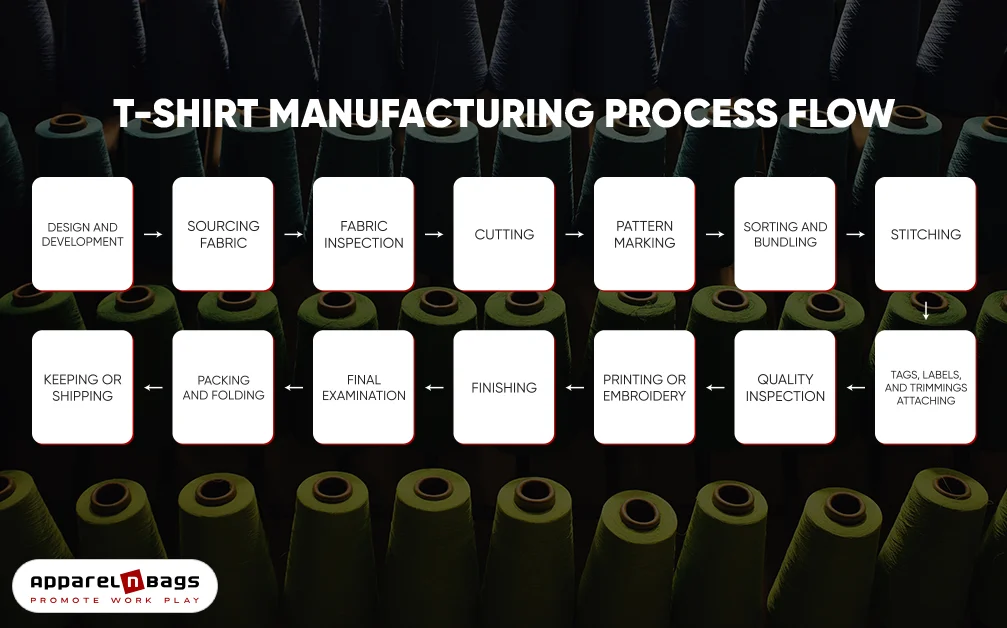
Development and Design
The buyer submits a design concept to the merchandiser, or the merchandiser develops a fresh design itself. Graphic designs, logos, patterns, or any other artwork that is to be printed or embroidered on the t-shirts may be included at this stage.
Once the buyer finalizes the design concept, the merchandiser will create the technical drawings and specs. These include dimensions, color schemes, artwork arrangement, and other particular requirements.
The manufacturer then creates prototypes and sends them for approval to the customer, where they make sure the samples adhere to the required standards.
Sourcing Fabrics
Based on the mentioned qualities, such as fabric type, GSM (grams per square meter), color, and texture, the merchandiser sources the fabric from suppliers. When choosing fabrics, durability, comfort, and price are taken into account.
The merchandiser places the order with a supplier after making sure that the fabric meets the described functionalities.
Fabric Inspection
The fabric inspectors closely examine each cloth roll to look for flaws, differences in color or texture, or any kind of imperfections. If any defect is found in the roll, that part of the roll is removed before production begins. The quality assurers make sure only cloth of the highest standard is used in the manufacturing process. It promises to meet customer’s requirements for premium quality t-shirts.
After the inspection, the manufacturer initiates production.
Cutting
The cutting table is covered with layers of fabrics one on top of the other.
The fabric layers are then cut, using automated or manually operated cutting equipment, as per the templates’ contours. The fabrics are cut based on the design and other requirements.
Pattern Marking
Meanwhile, talking about pattern marking on t-shirts, digital marking systems and manual techniques both are used for the purpose. The marking begins by placing the full-size patterns on the marking paper or marking sheet.
Marking paper is printed paper, bearing markings to make sure the shape of each component of the design follows a specific pattern.
To keep the marking in place, workers secure the fabric with pins or staples. Some producers use heat adhesives to help them stick to the fabric’s top layer.
Bundling and Sorting
The pre-stitched t-shirts are sorted and bundled up together based on patterns, sizes, colors, and similar characteristics. The bundles are labeled with pertinent information for simple identification and tracking, such as size, color, order number, design, pattern, or any other description.
Stitching
Afterward, the fabric pieces are then stitched together in accordance with the design and pattern by skilled operators to get the final product The stitching patterns and thread colors on sewing machines are predetermined.
This phase entails bottom hemming, sleeve hemming, sleeve joining with the body, top neck stitching, shoulder joining, top shoulder stitching, rib or neck joining with the body, and other necessary components.
Tags, Labels, and Trimmings Attaching
Usually, the t-shirts we wear have labels that contain information about the size, company logo, how to care for them, the fiber content, and other facts. Using a basic sewing machine, these labels and tags are stitched onto the t-shirts.
After placing the label, various trims are added, including buttons, zippers, patches, appliques, or other ornamental components.
Quality Inspection
The quality controller inspects the stitched t-shirts for any flaws or defects, such as loose threads, stretch marks, or anything else, to guarantee the garments match the aforementioned quality standards. If any flaw is found in any piece, either it will be resolved or the piece will be discarded.
Embroidering or printing
If the t-shirts need to be printed or embroidered with certain logos, messages, names, or any artwork, it is done at this stage using advanced customization methods like screen-printing, embroidery, or other methods.
Finishing
After sewing and printing, any excess thread or fabric is meticulously clipped to give the t-shirts a neat, finished look. The t-shirts are given a clean, polished appearance by steaming or conventional ironing.
Final Examination
To ensure the highest possible level of product quality, a final inspection is conducted. At this point, any necessary adjustments or touch-ups are applied.
Packing and Folding
The t-shirts are then folded neatly in accordance with the buyer's specifications or manufacturer’s signature style. Next, the t-shirts are packed in polybags or cardboard boxes and stored for shipping. Packaging is usually kept as compact as possible for easy storage.
Keeping or Shipping
Before shipping, the t-shirts are packed and kept in a warehouse for inventory control. The necessary paperwork is completed, including invoices, packing lists, shipping labels, etc., for a smooth shipment. Under the direction of the merchandiser, the consignment of t-shirts is subsequently delivered to the location specified by the buyer.